Bard Early College Ukraine
Launching a tuition-free, accredited 4-year high school in Kyiv by Fall 2028 to rebuild Ukraine’s human capital.
The Urgency: Why We Are Building This
Halting Human Capital Loss
In 2021, 14,700 first-year Ukrainian students enrolled abroad; by 2023, enrollment reached 115,000. In 2025, only 42% of young Ukrainians living abroad planned to return.
With optimistic scenarios projecting up to 55% of 18-24-year-olds staying abroad, the cost to our annual GDP could reach 2.3-9.5%. We are building a compelling, world-class reason for our brightest minds to stay.
Closing the Equity Gap
Ukrainian students are falling dangerously behind their OECD peers – by 32 points in math and 43 points in reading, equating to being 1.5 to 2 years behind globally.
The gap is worse internally: rural students score ~60 points lower than urban students, leaving them nearly 3 full years behind. We are bringing rigorous education to those who need it most.
Proof of concept
Phase 1: Proving the Model (Teaching Methodology) Works (Summer 2026)
The program followed Bard’s Institute for Writing and Thinking (IWT) practices: experiential learning, peer response, and reflective dialogue. Language & Thinking is the foundation of every Bard academic experience and is taught at nearly 30 sites worldwide, including all 10 Bard High School Early Colleges and a partner technical high school in Kyrgyzstan. Since 1982, IWT has modeled ways to help students develop careful reading, writing, critical thinking, and dialogue and has organized workshops globally, from Bangladesh and Myanmar to Tuskegee and Maui, and from Bishkek to Pittsburgh.
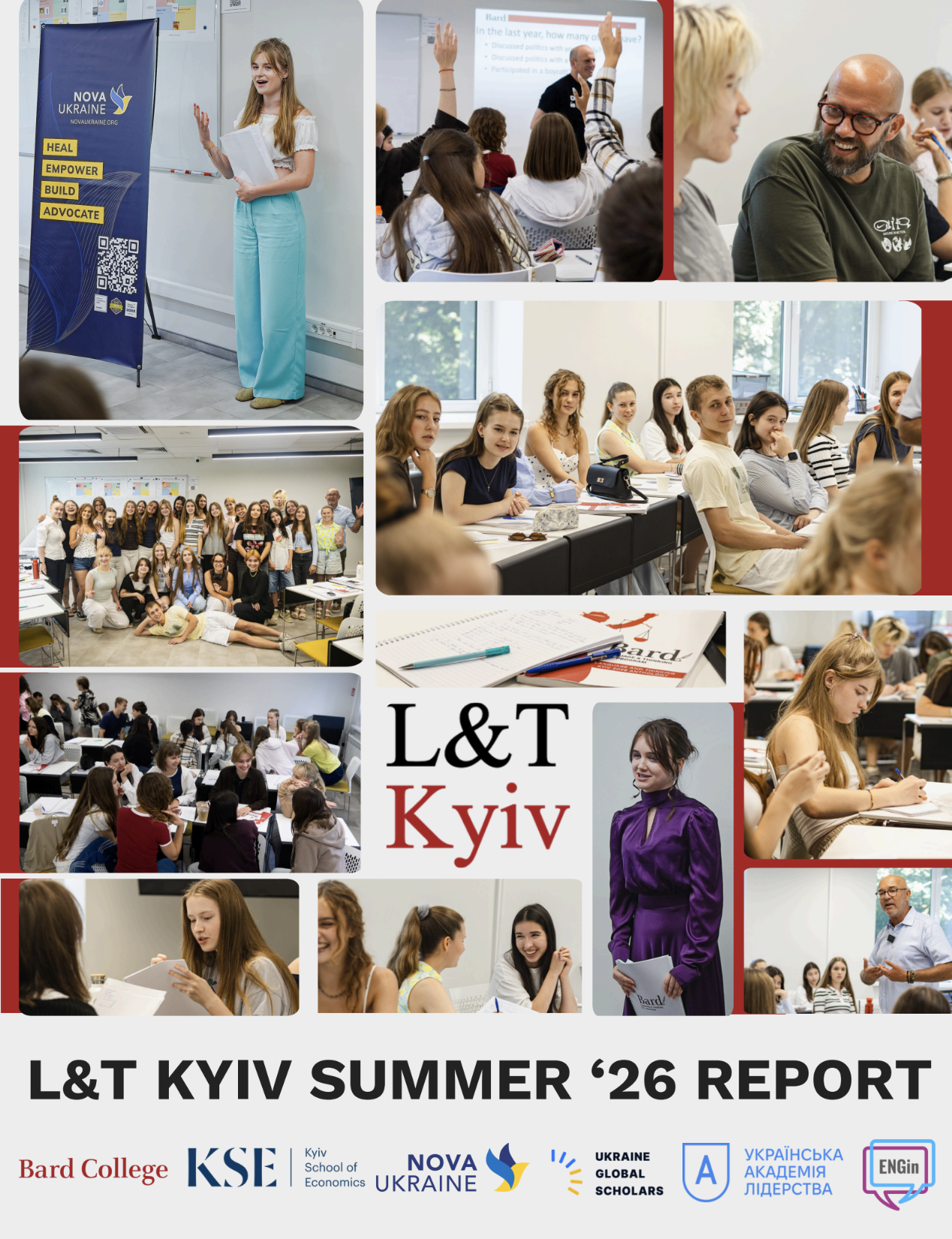
During Summer 2026, we successfully executed our Phase 1 proof-of-concept, the Bard Language & Thinking (L&T) Kyiv pilot.
Students came from Kyiv and across Ukraine, including Kropyvnytskyi, Irpin, Vinnytsia, Vablya, Kharkiv, Radyvyliv, Sumy, Ternopil, Uzhhorod, Cherkasy, Rudno, and Berdychiv. Listen to one of them here!
Text Reading
Disciplinary Analysis
Based on Evidence
Diverse Perspectives
Info & Evidence
Initiative
To National Issues
Program to Friends
Again
The initiative was funded through $4,425 in personal savings alongside $40,605 raised via strategic partnerships with Nova Ukraine, the Ukraine Global Scholars Foundation, and the Ukrainian Leadership Academy.
To prove our ability to scale equitable access, we successfully tested a fully secure residential model. We provided housing, bomb shelter access, meals, and comprehensive well-being monitoring for 10 students, actively removing geographical and financial barriers for youth originating from rural, frontline, and displaced communities.
The pilot delivered immediate, measurable returns on human capital:
(1) Complex Analysis: 96.5% of students improved their ability to independently comprehend and analyze complex academic texts.
(2) Cross-Disciplinary Thinking: 79.3% demonstrated enhanced capability to apply diverse academic frameworks to complex problem-solving.
(3) Civic Action: 75.8% successfully connected their academic learning directly to national recovery issues, with graduates subsequently joining local youth councils and launching independent community projects.
This pilot explicitly proved that our internationally recognized critical-thinking methodology works in Ukraine. It established the foundational operational and academic framework required to scale into the 136-student Mini BEC Ukraine 2027 pilot, and ultimately, our Fall 2028 permanent institutional launch.
What exactly did we do in Summer 2026?
We brought 29 Ukrainian high school students to intensive writing workshops at Kyiv School of Economics, led by Phil Pardi, Bard’s Director of College Writing, and Liliana Tymchenko, Associate Professor at European Humanities University. Using a Justice-themed anthology featuring Václav Havel, Lesia Ukrainka, Martin Luther King Jr., and others, students wrote before, during, and after reading, shared work with peers, and engaged in rigorous interdisciplinary discussions.